








John Deere 35G Review
Written by Luis Montes Updated On June 23, 2026

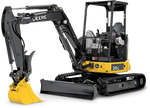
The John Deere 35G mini excavator is a versatile machine capable of handling gentle tasks for the average operator and more demanding jobs, such as digging out substantial tree stumps.
Jeffery, a member of Green Tractor Talk, claims he’s successfully removed 24” trees with his 35G, demonstrating its power under the right conditions.
The 3.5 metric tons of weight of this excavator—that’s what the 35G model tag means—makes it easy to trailer, and regardless of being a medium-sized model, it can get into tight areas and between trees.
We’ll thoroughly and objectively review the pros and cons of the 35G excavator, which, along with other equipment such as the JD G series compact track loaders, is among the most popular construction equipment in the US.
The Pros of the John Deere 35G

The 35G cab has good 360-degree visibility and more interior room than the D series. It also features a gripped platform and multiple handles for easy entry and exit.
The flippable foot pedals and the adjustable suspension seat (which includes a weight adjustment knob) further improve the legroom. Besides the two pedals to drive the machine, there’s a third one to swing the boom, with a lockout footrest to step on while not using it.
The 35G has hydraulic pilot-operated controls for the boom, arm, bucket, swing, boom swing, gear, travel, and auxiliary functions, making operations smooth.


Underneath the operator’s seat is a keyed door housing the pattern switch lever for switching between excavator and backhoe controls, and a switch to turn off the aux hydraulics to prevent unauthorized tampering with your machine.
Like most mini excavators, the 35G has a front roll-up window. It also has a hooking system to securely keep the door open for communication with coworkers or airflow. To release the door, just push down the lever beside the pilot control lever, which, by the way, is your only safety precaution once you enter the machine.
Other safety features on the 35G include lockable hatches for theft protection, thick Cordura sleeves covering the hydraulic hoses to protect against abrasion and rubbing, and convenient tie-down points.
The tie-down points are well distributed and large enough to prepare the 35G for hauling quickly. There are two on the blade, two on each side at the back of the tracks, and a big tie-down underneath the machine at the rear.

Unlike other John Deere equipment, like the 333G compact track loader, the 35G’s hydraulic oil sight glass is in plain sight, and its components are easily accessible. The rear compartment houses the filters and oil fill, while the right-hand panel houses the radiator, battery, cooling system reservoir, water separator filter, and fuel shutoff switch.
There’s one more compartment near the front of the machine housing the diesel fuel and hydraulic oil fills. Although the diesel fuel cap isn’t tethered, it has a large particle screen, which you can consider a third filter in addition to the machine's primary and secondary fuel filters.
To help you keep track of service intervals, the 35G has a handy sticker on the back window with all the information you need for periodic maintenance.
Since maintenance also involves proper operation, there’s another sticker on the right-hand side of the cab with the lifting capacity information based on different variables.
You can tweak the 35G's configuration with three track options: rubber, steel, and rubber pads, as well as a standard or longer stick.
Regarding the stick/arm/dipper of the 35G, the canopy version comes with the standard arm. Choosing a longer dipper will also include an extra rear counterweight.
The 35G has a sloped undercarriage design to reduce material buildup and grease track adjusters (like most tracked heavy equipment).
Although automatic quick coupler systems seem to be the go-to option, the 35 G's manual coupler lets you swap attachments in 2-3 minutes.
John Deere describes its wedge-style quick coupler as a wear-preventing, or anti-wear, system. The design lets you tighten it as far as needed to compensate for play caused by wear and tear at the joints, extending the life of the bucket and the coupler system.Unlike other John Deere equipment, like the 333G compact track loader, the 35G’s hydraulic oil sight glass is in plain sight, and its components are easily accessible.
The rear compartment has filters and the oil fill, while the right-hand panel has the radiator, battery, cooling system reservoir, water separator filter, and fuel shutoff switch.
There’s one more compartment near the front of the machine housing the diesel fuel and hydraulic oil fills. Although the diesel fuel cap isn’t tethered, it has a large particle screen, which you can consider a third filter besides the machine’s primary and secondary fuel filters.
To help you keep track of the service hour intervals, the 35G has a nice sticker on the back window with all the information you need for periodic maintenance.
Because maintenance also involves proper operation, there’s another sticker on the right-hand side of the cab with the lifting capacity information based on different variables.
You can tweak the 35G’s configuration with three track options: rubber, steel, and rubber pads, as well as a standard or longer stick.
Regarding the stick/arm/dipper of the 35G, the canopy version comes with the standard arm. Choosing a longer dipper will also include an extra rear counterweight.
The 35G has a sloped undercarriage design to reduce material from building up and grease track adjusters (like most tracked heavy equipment).
Although automatic quick coupler systems seem to be the go-to option, the 35 G’s manual coupler allows you to swap attachments within 2-3 minutes.
John Deere describes its wedge-style quick coupler as a wear-preventing (anti-wear) system. The design lets you tighten it as needed to compensate for play caused by wear and tear at the joints, extending the life of the bucket and coupler system.
The Cons of the 35G Mini Excavator

Photo source: www.agprocompanies.com
Let’s start with the quick coupler. The standard factory buckets aren’t compatible with the hydraulic quick coupler, so you’ll have to buy a new set if you decide to get it.
One major drawback of the 35G is that it stalls when using multiple hydraulic systems at once.
The problem is especially noticeable when using a mower or mulcher. You can’t continuously run the attachment without turning off other hydraulic functions. For instance, the excavator can’t raise the arm while the blade is running. You can lower the arm, rotate, and even track, but you don’t have enough flow to lift the arm without getting off the cutter flow.
Some owners complain about the same issue even while doing regular stuff, like using the boom, stick, and tracks at the same time. Don.S, a senior member of the Heavy Equipment forum, says, “If you track and try to use the stick and boom at the same time, the tracks would slow, and if on a slope, they would stop.”
Another issue with the 35G compact excavator is the backup alarm, which is more of a movement beeper, sounding regardless of whether the machine is moving backward or forward.

Since it can be annoying, the machine includes a kill switch next to the display panel. However, the beeper will reset once the levers return to neutral. Some owners have decided to unplug the alarm— the connection is beside the radiator.
The 35G display panel is pretty rudimentary. It’s one single color, not a touch screen, not radio-integrated, and not camera-capable. You can use it to check the operation hours, the trip meter, fuel and temperature gauges, set the clock, etc.
The radio's factory position is kind of awkward. It’s next to your left elbow. Many owners say they often hit the radio with their elbows and can even accidentally turn it off if they are tall guys, hitting the top of the radio.

Keep an eye out for the lowest AC vent. Guys accidentally rip out the vent with the back of their heels when it’s oriented downward. We recommend keeping that particular vent oriented upward at all times.

The 35G compact excavator is John Deere's biggest non-DPF (Diesel Particulate Filter) machine. When the exhaust gases cool down and condense, they form a black, oily liquid in the tailpipe—a mixture of oil, unburned fuel, and soot.
Specifications of the 35G Mini Excavator
The 35G mini excavator has a zero tail swing design, allowing it to rotate within the width of its tracks. Operators can focus on their work without worrying about damaging the machine or nearby property.
General Specs
| Model | 35G with Long Arm, Cab, Extra Counterweight, and Rubber Tracks (For additional information, click the link below to check the entire brochure) |
||
|---|---|---|---|
| Engine | Model | Yanmar 3TNV88F | |
| Net Power - HP (kW) / rpm | 23.3 (17.4) / 2,400 | ||
| Hydraulic system * | Flow of auxiliary hydraulics - GPM (l/min) | 16.2 (61.2) | |
| Powertrain | Travel speed - mph (km/h) | Low | 1.7 (2.8) |
| High | 2.7 (4.3) | ||
| Tumbler distance - ft. in. (mm) ** | 5 ft. 5 in. (1,660) | ||
| Ground contact pressure - psi (kPa) | 4.53 (31.2) | ||
| Swing system | Swing speed - rpm | 9.0 | |
| Boom swing angle - degrees | Right | 62 | |
| Left | 72 | ||
| Operating weight (Including operator’s weight @ 175 lbs) - lbs (kg) |
8,175 (3,953) | ||
| Operating Dimensions | |||
| A | Maximum cutting height | 15 ft. 7 in. (4,740 mm) | |
| B | Maximum dumping height | 11 ft. 1 in. (3,390 mm) | |
| C | Maximum digging depth | 11 ft. 4 in. (3,460 mm) | |
| D | Maximum digging reach | 18 ft. 1 in. (5,520 mm) | |
| E | Minimum front swing radius | 7 ft. 7 in. (2,300 mm) | |
| F | Transport length | 15 ft. 7 in. (4,750 mm) | |
| Machine Dimensions | |||
| G | Upper structure width | 5 ft. 1 in. (1,550 mm) | |
| H | Transport height | 8 ft. 2 in. (2,480 mm) | |
| I | Track width | 12 in. (300 mm) | |
| J | Undercarriage width | 5 ft. 9 in. (1,740 mm) | |
| K | Ground clearance | 11 in. (280 mm) | |
| L | Tail swing radius | 39 in. (980 mm) | |
| M | Engine cover height | 5 ft. (1,530 mm) | |
| N | Maximum blade lift above ground | 14.2 in. (360 mm) | |
| O | Maximum blade drop below ground | 15.7 in. (400 mm) | |
| P | Sprocket center to idler center (tumbler) | 5 ft. 5 in. (1,660 mm) | |
| Q | Undercarriage length | 6 ft. 11 in. (2,110 mm) | |
| R | Counterweight clearance | 22 in. (550 mm) | |
| Lift Capacities | |||
| Attachment on ground level and arm with a reach radius of 10 ft - lb. (kg) | Over front | Over side | |
| 3,307 (1,501) | 1,756 (797) | ||
* Open center with 2 variable-displacement pumps and 1 fixed-gear pump.
** The tumbler distance is the measurement between the centers of the front idler and the sprocket on the tracks. It affects the machine's stability and operation.
Link to the complete brochure

Image source: www.deere.com

Standard Features and Some Under the Radar
Like many mini excavators, the 35G also features fuel-saving technologies, such as auto-idle, which automatically reduces engine speed when you aren’t using hydraulics, auto shutdown if the machine is left idle for a set time, and the power/economy modes.
The power/economy modes also limit the 35G RPMs, impacting fuel consumption. The power mode is suitable for heavy tasks, while the economy mode is for lightweight tasks or transportation.
The John Deere 35G also features an automatic downshift for safe travel. It slows down the track speed whenever carrying a heavy load (according to the sensors). When the load “normalizes,” the tracks return to high speed.
Telematics is becoming essential to the heavy equipment industry, and the 35G isn't an exception. The JDLink connectivity service provides remote diagnostics and support. Know your machine location, get data to monitor machine health, and receive alerts to help you maximize productivity and efficiency.

However, some of the features of the 35G might go unnoticed. Check these out:
- A one-inch steel plate between the boom and arm.
- One-inch steel plates reinforce the boom base.
- A single-pin swing post reduces wear and strengthens the boom base joint (see image above)
- Porous oil-impregnated bushings. If you forget to lubricate a grease zerk, the oil inside the bushings secretes oil to lubricate parts and prevent friction damage.
We highlight the first three features because most competitors use cast-iron plates instead of steel and dual-pin systems to swing the post, which takes us to the next section of this review.
The 35G vs the Competition

Photo sources: www.ritchielist.com
| JOHN DEERE 35G COMPARED AGAINST THE COMPETITION (WITH CAB, RUBBER TRACKS, AND STANDARD ARM) |
||||
|---|---|---|---|---|
| Model | John Deere 35G | Kubota U35 | Bobcat E35 | Cat 303.5 E2 |
| PERFORMANCE | ||||
| Tail Swing | Zero tail | Zero tail | Zero tail | Zero tail |
| Operating Weight - lb (kg) | 8,135 (3,690) | 8,478 (3,845) | 7,659 (3,474) | 8,139 (3,692) |
| Max Digging Depth | 10 ft. 0 in. (3,060 mm) |
9 ft. 8.9 in. (2,970 mm) |
10 ft. 1.2 in. (3,077 mm) |
9 ft. 6 in. (2,880 mm) |
| Max Dump Height | 11 ft. 4 in. (3,460 mm) |
11 ft. 0.7 in. (3,370 mm) |
11 ft. 5.2 in. (3,484 mm) |
11 ft. 6 in. (3,520 mm) |
| Max Reach | 17 ft. 1 in. (5,210 mm) |
16 ft. 11.3 in. (5,165 mm) |
17 ft. 0.3 in. (5,190 mm) |
16 ft. 8 in. (5,060 mm) |
| Max Bucket Digging Force - lb (kg) | 6,085 (2,760) | 7,924 (3,594) | 7,284 (3,304) | 7,419 (3,365) |
| Max Arm Digging Force - lb (kg) | 4,277 (1,940) | 4,451 (2,019) | 4,690 (2,127) | 4,249 (1,927) |
| ENGINE | ||||
| Net Power - hp (kW) | 23.3 (17.4) | 23.9 (17.8) | 24.8 (18.5) | 31.6 (23.6) |
| UNDERCARRIAGE | ||||
| Ground Pressure - psi (kPa) | 4.8 (33.0) | 5.08 (35.0) | 4.6 (31.72) | 4.7 (32.1) |
| Travel Speed Low Range - mph (km/h) |
1.7 (2.8) | 1.9 (3.0) | 1.6 (2.6) | 1.6 (2.6) |
| Travel Speed High Range - mph (km/h) |
2.7 (4.3) | 2.9 (4.6) | 2.9 (4.7) | 2.8 (4.6) |
| HYDRAULIC SYSTEM | ||||
| Auxiliary Hydraulic Flow - gpm (L/m) |
16.2 (61.2) | 15.8 (60) | 16.9 (63.9) | 15.9 (60) |
| DIMENSIONS | ||||
| Width | 5 ft. 9 in. (1,740 mm) |
5 ft. 6.9 in. (1,700 mm) |
5 ft. 9 in. (1,753 mm) |
5 ft. 10 in. (1,780 mm) |
| Heigh | 8 ft. 2 in. (2,485 mm) |
8 ft. 1.2 in. (2,470 mm) |
8 ft. 0.24 in. (2,444 mm) |
8 ft. 2 in. (2,500 mm) |
| Length (Transport) | 15 ft. 3 in. (4,640 mm) |
15 ft. 7 in. (4,749 mm) |
15 ft. 9.9 in. (4,824 mm) |
15 ft. 6 in. (4,730 mm) |
Every model has a good maintenance design. Nothing feels too tight and is easily accessible. The major differences are the way the hoods open and the locations of some fills. For instance, the 35 G's fuel tank inlet is in the front compartment, whereas the competition's is next to the entry door.
Regarding the hoods, the JD 35G, the Cat 303.5 E2, and the Kubota U35 have a combination of side and upward swing doors. In contrast, the hoods on the Bobcat E35 open upward and include removable covers for further access to components.
John Deere and Cat offer standard and long-arm versions of their mini excavators. The Bobcat E35, on the other hand, has an optional extendable arm. The stick can be extended up to 30 in. if needed and retracted to its standard position for maximum arm force and lift performance.
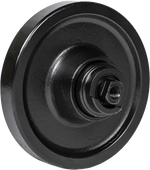
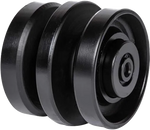
The Kubota U35 and Bobcat E35 have dual-flange track rollers, whereas the JD 35G and Cat 303.5 E2 have single center flange rollers. The dual-flange rollers provide greater stability during slewing or digging over the side and a smoother ride when moving across bumpy job sites. Plus, they distribute the machine’s weight better along the track length.
Things we thought worth comparing in the operator station are:
- The display panel.
- The legroom.
- The switches and buttons layout.
The Bobcat E35 has the best display panel by far. It’s a digital touchscreen with integrated radio, camera, and Bluetooth. The display panel on the Cat 303.5 E2 looks nice. However, it’s not touchscreen, radio-integrated, or camera-capable. The 35G and U35 screens are single color, and neither has integrated radio or camera functions.
The John Deere 35G and Kubota U35 feature two flipable pedals and a third pedal for boom swing, which reduces legroom. The Bobcat E35 and Cat 303.5 E2 have only two pedals. However, those on the 303.5 E2 don’t fold and can get in the way when not in use. The E35 and the 303.5 E2 have their boom swing function on the left lever.
Finally, the switches and buttons on the Bobcat E35 cab are in front of the operator. The Cat 303.5 E2 has most of its switches at the front, except the radio, which is up off the top.
The JD 35G and the Kubota U35 have their radio and AC controls on each side of the operator seat, though Kubota pushed them further back.
Testimonials
Both companies below praise the reliability and versatility of the 35G mini excavator, which has been a critical factor in completing their projects.
Jeromy Godwin and Justin Pourron, president and secretary of Barbour & Pourron Plumbing Service, claim the 35G can get in tight spots, is light enough to haul easily, and still has the power to do the jobs they need.
Adam Bailey, the owner of Bailey Landscape, walked us through one of his job sites and told us how the Jon Deere 35 mini excavator rental from Rent1USA made his work significantly easier. Check it out.
Wrapping Up
The John Deere 35G mini excavator is a reliable and durable machine. Its medium size allows you to work in tight spots and haul it quickly, yet the 35G is powerful enough to tackle all sorts of tasks, even digging out 12” or bigger tree stumps.
If you wish for more power (like many Kubota KX040 owners), check out our John Deere 60G review.