






A Thorough Explanation of Heavy Equipment Idlers: Purpose, Types, and Wear Signs
Written by Luis Montes Updated On September 25, 2024

Heavy equipment wheel idlers have several purposes:
- Bear some of the loads from the machine (track rollers mainly handle loads).
- Prevent track derailment.
- Guide the track so it rotates smoothly in a loop.
- Along with the track adjuster, the front idler tensions the rubber track to make it work properly.
Let’s discuss some idler types and wear signs and consider the clever mechanism of the track adjuster system in detail.
Types of Wheel Idlers

Depending on the sprocket’s position within the undercarriage, machines can have a single front idler or a rear and front idler.

The undercarriage’s design also impacts the size of the idlers. Conventional undercarriages have idlers bigger than rollers, which let the track loop without crashing into the undercarriage frame.
Thanks to their open-style undercarriages, brands like ASV can have roller-size idlers on some skid steers.
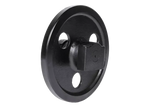
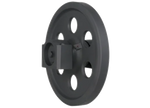
Some idlers can also have holes, which, according to Josh Davyduke, Fortis HD parts specialist, “make the idlers lighter while ensuring material doesn’t pile up and block anything, causing issues when hardening.
Idlers with holes are typically only seen on smaller units. Larger excavators and dozers feature solid idlers as these need to bear more weight.”
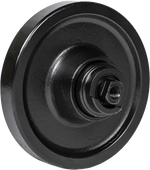
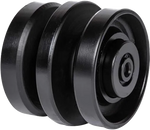
Like rollers, idlers can be single or dual-flanged. Dual-flanged idlers offer more stability than single-flanged idlers, further reducing the chances of detracking and spreading loads over a wider area.
Since excavators usually stay stationary and don’t cruise over challenging terrain, they can rely on a single-flanged front idler.
On the contrary, compact track loaders can have a mix of single and dual flange idlers (front and rear). While dual flange idlers increase traction and track retention, single flange idlers reduce material buildup, which is particularly beneficial at the rear side of skid steers to extend the sprocket lifespan.
Components of Idlers and Wear Signs

Despite subtle differences, the internal components of idlers are the following:
- Shell/idler (1).
- Shaft (2).
- Bushings (3).
- O-rings (4).
- Seals (5).
- Covers (6).
- Bolts (7).
- Washers (8).
- Plug (9).

Because idlers bear some of the machine’s weight and loads, they will gradually chip, reducing their size, and eventually fail when their bearings wear down and fall off the idler’s shell.
The most common sign of wear is clanging noises due to the shell riding directly on the shaft.

Track Adjuster

Track adjusters can be hydraulic or mechanical.
Conventional hydraulic and mechanical track adjusters have two purposes:
- Push the front idler to tension the track.
- Their spring absorbs shock loads during operation, protecting its hydraulic system and other undercarriage components.
Some track tensioners, like those on ASV machines, don’t have a spring but rely on the poly cord technology of their rubber tracks to absorb shock loads.
Let’s examine the mechanism of conventional track adjusters to better understand how they tension tracks and absorb shock loads. We’ll also mention an important safety precaution while servicing this component.

Hydraulic track adjusters use grease to fill a cylinder, pushing a rod, which moves the entire assembly, including the front idler.

On the other hand, mechanical track tensioners rely on a threaded rod that pushes the assembly and the idler as the rod turns — similar to a lead screw mechanism.
Both systems feature a pre-compressed spring that counters the action of shock forces. A plate and the yoke hold the spring, and because the bolt passes through an unthreaded hole, the yoke can retract when shock forces act on the front idler.

The compressed spring stores potential energy called “restoring force,” which acts outward and greatly reduces the effect of shock forces on the front idler.
Track adjusters, especially hydraulic ones, also wear down. Over time, their seals crack and can’t hold the grease, making tracks constantly loose. Also, the springs can rust to the point they’ll break.
When changing the front idler, DO NOT remove the bolt retaining the spring. It will immediately go to its resting position, hurting you badly. If you need to remove the nut, use a hydraulic press to retract and hold the yoke while taking the nut out.
Wrapping Up
Idlers guide rubber tracks to loop properly while reducing the chances of popping off from the undercarriage.
Wheel idlers can have one or more flanges, depending on whether you require less wear due to material buildup or to increase traction and track retention despite more soft material packing in the undercarriage.
Like rollers, idlers rely on bearings to roll while supporting considerable loads. Bearings are prone to wear to the point where they’ll fall off the idler’s shell. Squealing or grinding noises from your undercarriage are signs of rollers or idlers without bearings.
Was this post useful? If so, consider sharing it with colleagues and friends. For more heavy equipment undercarriage articles, check the Fortis HD blog.